Feathered Traffic Control: The Crow Network That Beats the M6 Travel Bulletin to Work
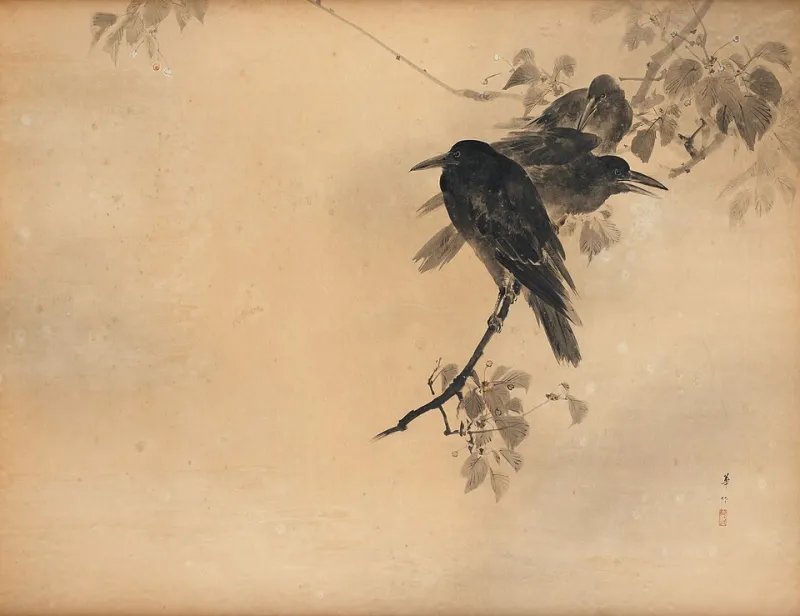
Photo: Suzuki Kason, Public domain, via Wikimedia Commons
Every morning at 5.40am, somewhere between junctions 13 and 15 of the M6, a lorry driver named Keith performs a ritual. He glances up at the gantries, notes where the crows are sitting, and adjusts his route accordingly.
"If they're spread out along the fencing, it's clear sailing," he tells us, nursing a service station tea of frankly criminal strength. "If they've all bunched up near a slip road, something's happened. Every time. I've been doing Preston to Birmingham for nineteen years and I trust those birds more than I trust the radio."
Keith is not alone. And, unsettlingly for the people paid to run our traffic reports, Keith might be right.
The Gantry Committee
Ask around the services along Britain's longest motorway and a picture emerges: an informal network of carrion crows, hooded crows and the occasional magpie consultant, perched at strategic intervals like a feathered control room. Regulars at roadside stops from Rugby to Carlisle describe the same phenomenon — the birds simply seem to know.
"There was a spillage near Stafford last spring," recalls Denise, who works the night shift at a services franchise. "Cones went down at half four. By quarter to five there were forty crows on the nearside verge having the time of their lives, and not one of them had been there the night before. Somebody told them. I don't know who. I don't want to know who."
What the Scientists Say (Cautiously, Over Their Shoulders)
Dr Priya Ramanathan, a corvid cognition researcher, is keen to pour cold water on the mystical framing — before quietly admitting the water is lukewarm at best.
"Crows are extraordinary at spatial mapping," she explains. "They hold vast mental territories, they remember where food opportunities occur, and they learn the rhythms of human infrastructure faster than almost any other bird. A stretch of motorway is, from a crow's perspective, an incredibly reliable conveyor belt of carrion and dropped meal deals."
The key, she suggests, is not telepathy but pattern recognition stacked on pattern recognition. Crows learn the visual cues that precede congestion — brake light constellations, the behaviour of recovery vehicles, the particular way cones get deployed. A crow that has witnessed a few hundred incidents develops, in effect, a predictive model.
"Do they outperform a journey planner?" Dr Ramanathan pauses. "For a two-mile stretch they know intimately? Possibly, yes. They're also not stuck in traffic while they check."
The Scouting Reports
Back on the hard shoulder of public opinion, the anecdotes get stranger. Keith swears he's been "scouted" — that after he stopped and shooed crows away from a dead badger one grim Tuesday, they subsequently followed his cab for three junctions, landing on lampposts as he passed.
"Watching me. Judging me. Making notes," he says, entirely without irony.
Another reader, who asked to be identified only as Margaret from Wigan, reports that the crows near her stretch of the M58 "queue politely at the same three spots every rush hour, like they've read the Highway Code and decided it's more of a suggestion."
Whether crows hold grudges, run reconnaissance or simply enjoy the theatre of a motorway is beyond the scope of this article. What is clear is that Britain's commuters are surrounded by a distributed, self-updating, zero-carbon traffic sensor network that costs the taxpayer precisely nothing and occasionally eats a pasty.
Should You Trust the Birds?
Our official position at Animail: if a crow is sitting calmly on a gantry, crack on. If a murder of them has gathered on the verge looking like a committee that's just been handed bad news, take the A-road.
And if you pass Keith, give him a wave. He's earned it. His co-pilots have eyes everywhere.