Midnight Snack Cartography: How Your Bin Becomes a Data Point for Britain's Fox Scientists
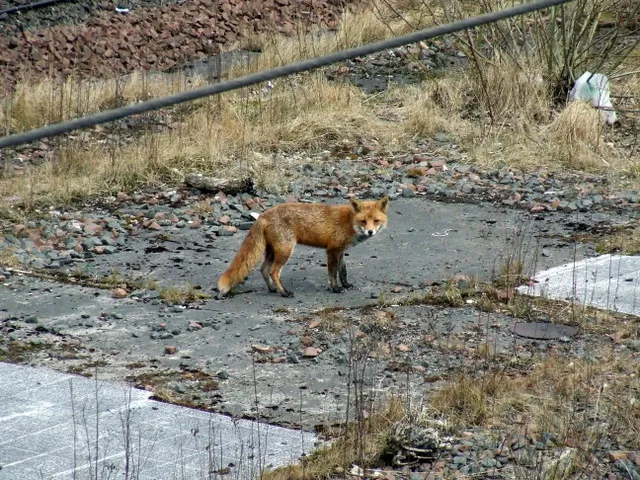
Photo: Thomas Nugent , CC BY-SA 2.0, via Wikimedia Commons
There is a moment familiar to millions of Britons. You wake at some ungodly hour to a crash outside, peer blearily through the curtains, and catch a flash of russet tail disappearing over the fence with what appears to be a naan bread in its mouth. You sigh, you mutter something unprintable, and you go back to bed.
What you may not realise is that you've just become a research assistant.
Your Garden Is a Field Station (You Just Didn't Sign the Paperwork)
Urban foxes are, by headcount, one of Britain's most closely observed wild mammals — not because of any government scheme, but because we simply can't stop watching them, filming them, and complaining about them. Ecologists have cottoned on. Projects like the long-running fox surveys run by university researchers and wildlife trusts now rely heavily on exactly the kind of accidental data collection the British public produces nightly: trail camera clips, Facebook group sightings, and the noble science of bin forensics.
That torn-open black sack in the alley isn't just a nuisance. It's evidence. What a fox eats, when it eats it, and how bold it's become all tell researchers something about the health and habits of the local population. A bin raided neatly at 3am in Bristol says something different from a daytime raid in Croydon.
The Rise of the Garden Trail Camera
Ten years ago, trail cameras were the preserve of deer stalkers and wildlife documentary crews. Now they're a £40 impulse buy from a garden centre, and thousands of them blink unblinkingly at British patios every night. The result is a staggering archive of fox behaviour that no research team could ever film alone.
Researchers mining this kind of footage have learned that urban foxes are creatures of habit, often patrolling the same circuit of gardens like a furry milkman with no milk. They've documented foxes using garden fences as motorways, dodging one another by minutes, and — a perennial favourite — pausing to stare directly into the lens with an expression of pure, unbothered disdain.
What Your Bins Reveal
The wheelie bin, it turns out, is a scientific instrument. Foxes that successfully defeat a locking clip are typically older, more experienced animals. Foxes that resort to scattering the recycling across the driveway are often youngsters learning the trade — the equivalent of a teenager burning the toast. Repeated raids at the same property usually mean a den nearby, often within a few hundred metres.
And the screeching? That bloodcurdling 2am scream that has half the street checking the news? Entirely normal. It's fox communication — territorial disputes and courtship, mostly peaking in the winter mating season. Alarming, yes. Evidence of a big cat, no. We checked. It's never a big cat.
How to Join the Census (Without Trying Very Hard)
If you'd like to make your fox-related grievances officially useful, you can. Organisations such as the Mammal Society and various local mammal groups run recording schemes where a quick sighting report — date, location, what the fox was doing to your bins — becomes a genuine data point. Garden trail camera owners can submit footage to urban wildlife projects studying everything from fox density to how our cities' night-time layouts shape their territories.
A few tips from the pros:
- Note the time. Timing tells researchers whether foxes are truly nocturnal in your area or shifting activity to avoid people and dogs.
- Photograph the evidence. A bin raid scene, paw prints in frost, or a dropping on the lawn are all identifiable and reportable.
- Don't feed them. However persuasive those eyes are at 11pm. Fed foxes become bold foxes, and bold foxes become someone else's neighbour complaint.
The Republic of Foxistan
There's something gloriously British about the whole arrangement. We've built a sprawling network of unpaid, pyjama-clad observers, each monitoring a patch of territory from behind a kitchen window, all contributing — bin by raided bin — to a portrait of one of our wildest and most adaptable neighbours.
So the next time a fox wakes the street at 3am and makes off with your food waste caddy lid, take a breath before you reach for the mop. You haven't been burgled. You've been counted.
And somewhere, a researcher is genuinely grateful.